
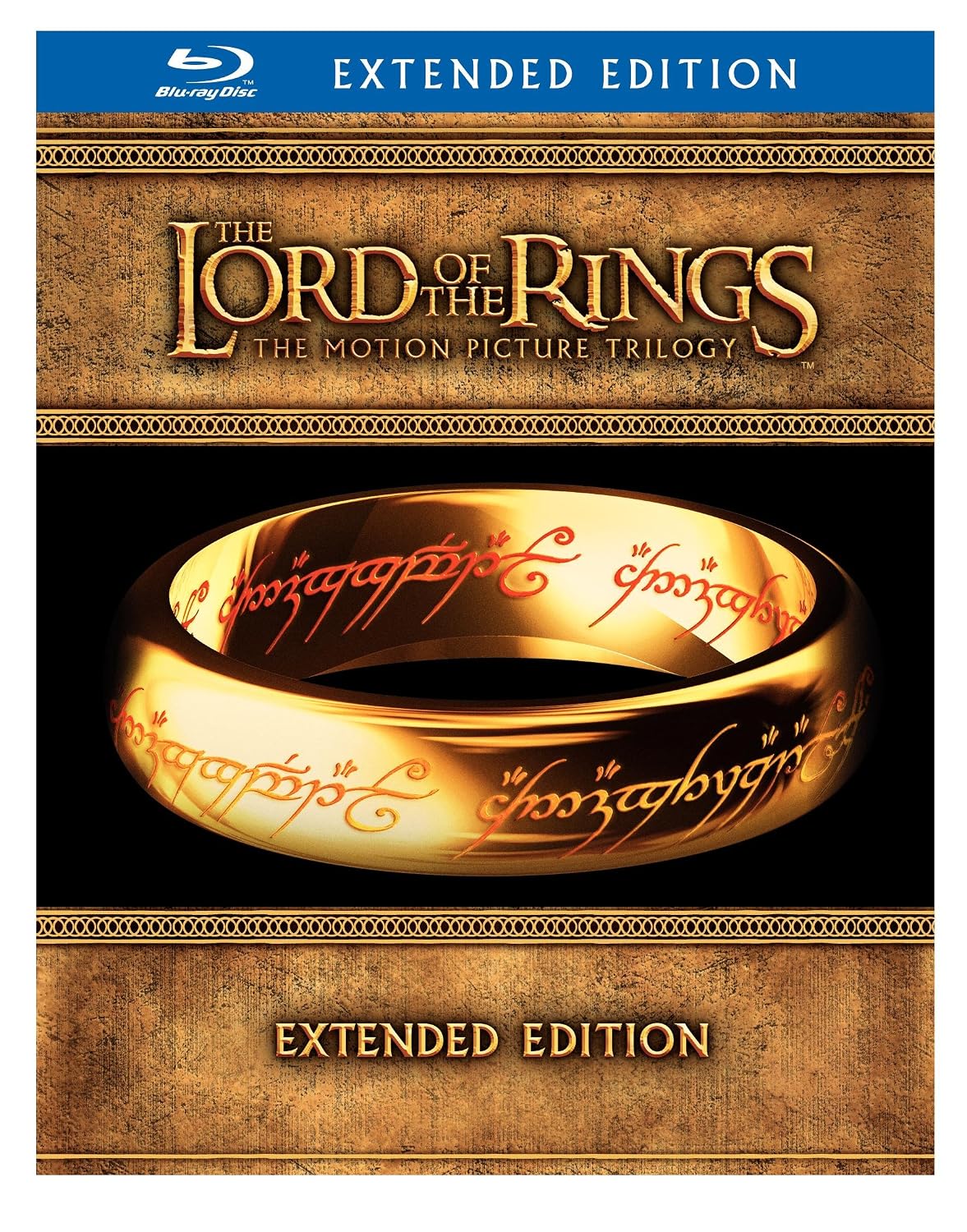
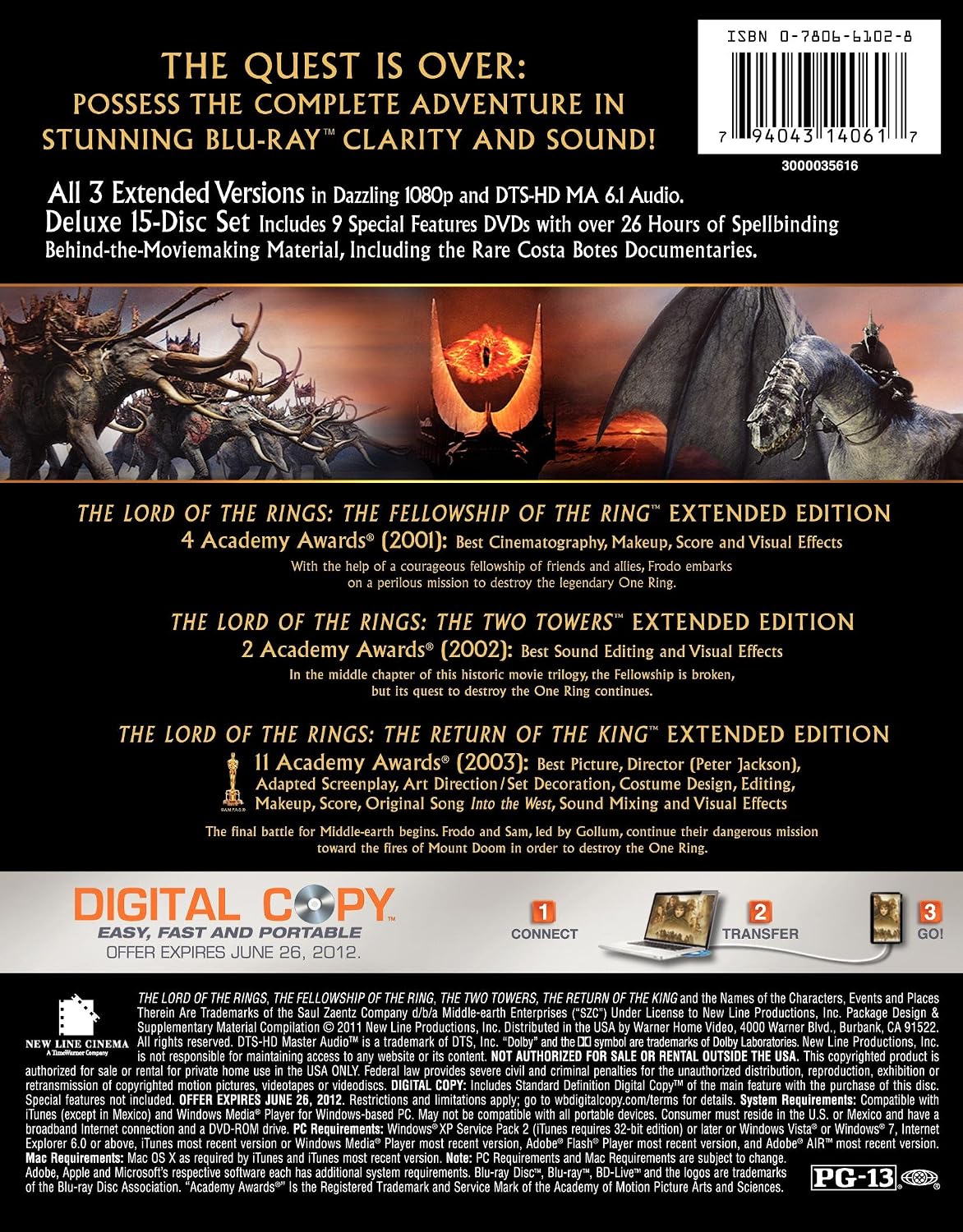
The Lord of the Rings Extended Edition Blu-ray set is the complete Middle-earth journey the way Peter Jackson wanted it seen: all three films in their longer extended cuts, plus more than 26 hours of behind-the-scenes material, across 15 discs. Released by New Line in June 2011, it was the first time the extended editions came to high definition, and it remains a cornerstone of any serious fantasy collection.
This is a brand-new copy. The Blu-rays are region free and the bonus DVDs are Region 1, so the whole set plays in standard US players.
Each film gets its own five-disc set: the movie split across two Blu-rays, two DVDs of Appendices, and a DVD with a documentary by Costa Botes. That adds up to 6 Blu-rays and 9 DVDs.
Runtimes include the extended fan-club credits. The theatrical cuts are not included in this set, and the original iTunes digital copy offer has expired.
The Lord of the Rings Extended Edition cuts restore scenes that deepen the story rather than pad it. You see more of the Shire and the Fellowship's gifts in Lothlórien, more of Faramir's history and the Ents in The Two Towers, and key character moments in The Return of the King, including the fate of Saruman. Together they add close to two hours of footage across the trilogy.
The Return of the King won 11 Academy Awards, including Best Picture, tying the all-time record. Across the trilogy, the films won 17 Oscars from 30 nominations.
The films are presented in 1080p at 2.40:1 widescreen with English DTS-HD Master Audio 6.1, so Howard Shore's score and the battle at Helm's Deep come through with full power. English SDH, Spanish and Portuguese subtitles are included.
The bonus material is why collectors hunt this set down. The Appendices, Parts 1 to 6, are some of the most detailed making-of documentaries ever produced for a film series. You also get three feature-length documentaries by Costa Botes, filmed on set during production, plus four commentary tracks each on Fellowship and The Two Towers and three on The Return of the King. The extras were produced in standard definition, which is why they are on DVD.
Together the three extended films run about 726 minutes, a little over 12 hours, including the extended fan-club credits. That is roughly two hours more than the theatrical cuts.
Because each film is split across two Blu-rays, you will change discs once per movie, usually at a natural break in the story. Most fans watch one film per evening, or plan a full marathon weekend. If you want to watch in story order, the sequence is simple: The Fellowship of the Ring, then The Two Towers, then The Return of the King.
Each film's two DVDs of Appendices cover everything from adapting Tolkien and designing Middle-earth to the Weta Workshop creatures and the music. Many collectors work through the Appendices between films, which turns the Lord of the Rings Extended Edition into a complete film school course on how the trilogy was made.
This is the 2011 Lord of the Rings Extended Edition set on Blu-ray, not the 2020 4K remaster. The 4K release has a newer color grade and Dolby Atmos, but the 2011 set is the one with the full Appendices and Costa Botes documentaries packaged alongside each film. Collectors should know that this pressing of The Fellowship of the Ring has a slightly warmer, greener color grade than other releases, which has been widely discussed by fans. If you want the extended cuts in HD with the complete bonus library in one box, this is the set.
Browse more complete collections in our box sets section and our movies on DVD and Blu-ray. If you are moving your collection up from DVD, our DVD vs Blu-ray guide explains the difference in picture and sound, and our gifts for movie lovers list has more ideas for fantasy fans.
For the full production and awards history, see The Lord of the Rings film series on Wikipedia.
Lord of the Rings Extended Edition Blu-ray: Questions Buyers Ask
How many discs are in the Lord of the Rings Extended Edition Blu-ray set?
15 discs: 6 Blu-rays with the three extended films and 9 DVDs of bonus material.
Why are some of the discs DVDs?
The Appendices and documentaries were produced in standard definition, so they are on DVD. The films themselves are on Blu-ray in full HD.
Are the theatrical versions included?
No. This set contains the extended editions only.
Is this the 4K version?
No. This is the 2011 Blu-ray set. The 4K remaster was released separately in 2020.
Will it play in my US player?
Yes. The Blu-rays are region free and the DVDs are Region 1.
This brand-new 15-disc set is in stock and is dispatched within two business days, and because it is over $50 it ships free anywhere in the US. Every order is covered by our 30-day return policy. It makes a standout gift for any Tolkien fan. Add it to your cart now and take the whole journey to Mount Doom.
Lukas –
Originally posted on Amazon.com · not a MarioShroomed purchase
本田和典 –
Originally posted on Amazon.com · not a MarioShroomed purchase
Dash –
Originally posted on Amazon.com · not a MarioShroomed purchase
flo_us –
Originally posted on Amazon.com · not a MarioShroomed purchase
B. Marold –
Originally posted on Amazon.com · not a MarioShroomed purchase
Extended cut alone is worth buying again
LIke many other reviewers, I have already reviewed the theatrical releases of each film, so I will concentrate on the value of the additions and of the “extras” CDs.
First and foremost, the time added to the theatrical edits is remarkable, from 20 minutes for “Fellowship” to an hour for “Return”. The value of the additions will depend a lot on how well you know the books. Since I have read LOTR about ten times, there was nothing new for me, and neither of the two “big” scenes cut from the book (Tom Bombadil and the Scouring of the Shire) are in the extensions. So, if you are not familiar with the novel, the added scenes will be a genuine treat. (By way of comparison, the 18 minutes added to “Avatar” made a huge addition for me, since it was all new material.)
Very few of the added scenes are outtakes. Most were shot especially to add those scenes to flesh out the story. I know of one exception, which was the short scene at the gates of Mordor where Aragorn and Gandalf parley with “the mouth of Sauron”. I looked forward to that scene, because “the mouth of Sauron” was played by Australian actor, Bruce Spence (of Mad Max fame).The scene was removed from the theatrical cut because “the mouth of Sauron” was suggesting that Sauron had aquired the ring, but the viewing audience new the ring was still safe.
If I were disappointed with anything, it would be that nothing of substance was added to break up the long, long, long winding down from the distruction of the ring to the last scene as the elven ship departs from the Grey Havens. That was the climax, immediately followed by three or more denouments, depending on how you count them. This is where that hour would have fit nicely, since that is exactly what it does in the book. It inserts one last dramatic chapter near the end, where there is some suspense and a chance that things can still become unravelled for the four hobbits.
For someone intimately familiar with the story, the greater value was to be found in the documentaries on the third and fourth disks for each film. As I watched each of these in turn, I was simply floored by the size of the crews working on all different aspects, from art, design, planning, costumes, props, set construction, miniatures, life size bodies (especially a lifesize figure of an Oliphant (mumakil) corpse for the battle of Pelannor Fields. And, that battle was even longer than in the theatrical release, which (since I just now checked) is far, far longer than the description in the novel.
It was astounding to see that some people, such as artists, costumers, model makers, and CGI crews spent up to seven years on the film. The main actors spent close to 2 years in New Zealand, including extra shots for the extended edition. The level of detail, to capture a very small effect, is remarkable. The costumes of the principle characters, most especially Theoden, were so elaborate, they had detailed designs on the inside, which you could not even see. There were two men who spent over two years doing nothing but making chain mail vests out of small rings of plastic pipe. Lots of people worked 12, 14, 16, and 18 hour days. One lead CGI artist spend his whole 2 week Christmas holiday constructing the computer model of Barad-dur, so that it could realistically be destroyed.
The job of the principal actors, especially those who appeared in all three films, seemed akin to spending a year in a Marine boot camp, and John Rhys DAvies had it the worst, as he was allergic to his prosthetics covering his face. In a dramatic scene, where Aragorn, Gimli, and Legolas are running after Merry and Pippin in Rohan, all three, Mortenson, Rhys Davies, and Bloom were injured in some way, but they soldiered on to keep the shooting on schedule.
The coordination of documentary segments from film to film was well done, as each one begins with the way Tolkien conceived of the story in each book, how design was done, how sets, costumes, and props were made, and how each was shot. I was floored when I saw the size of some of the sets. For Helm’s deep, virtually the whole fortress was built, in a quarry, which looked a lot like the Middle Earth terrain. The grandest set was Minas Tirith. It was the largest film set ever built in the southern hemisphere.
By the time I finished watching all the work that went into the films, I found it delightful to relive the moment at the Academy Awards when Stephen Spielberg opened the envelope for best picture and said “It’s a clean sweep.”