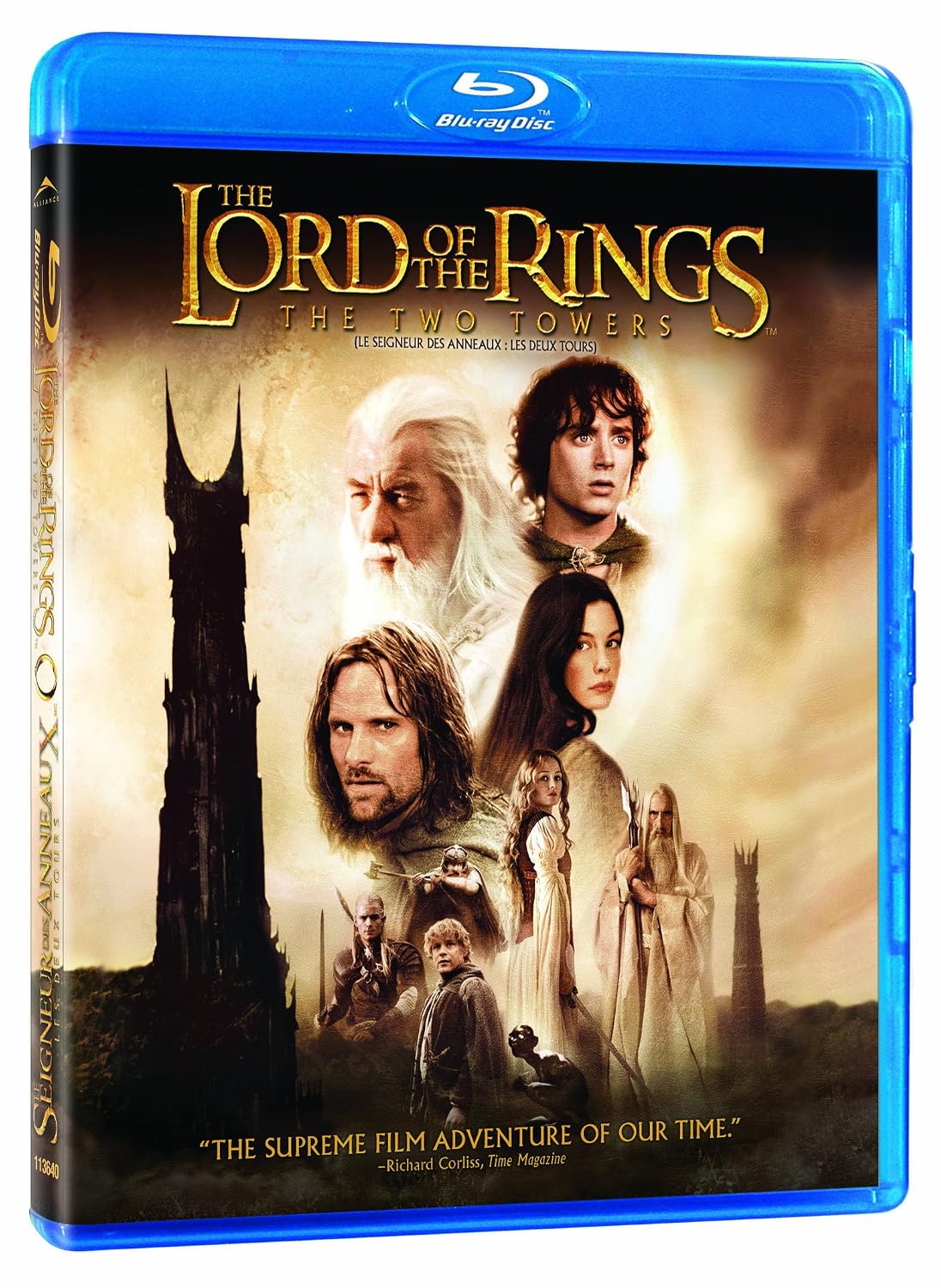
The Two Towers Blu-ray brings home The Lord of the Rings: The Two Towers, the second film in Peter Jackson's trilogy based on J. R. R. Tolkien's novel. As the Fellowship splits apart, Frodo and Sam head for Mordor with Gollum as their guide, while Aragorn, Legolas and Gimli race to rescue Merry and Pippin.
This is a Blu-ray release, so you will need a Blu-ray player or a game console that plays Blu-ray discs. It will not play in a standard DVD-only player.
What's in The Two Towers Blu-ray
- Film: The Lord of the Rings: The Two Towers (2002)
- Director: Peter Jackson
- Screenplay: Fran Walsh, Philippa Boyens, Stephen Sinclair and Peter Jackson
- Producers: Barrie M. Osborne, Fran Walsh and Peter Jackson
- Starring: Elijah Wood, Ian McKellen, Viggo Mortensen, Sean Astin, Andy Serkis, Orlando Bloom and John Rhys-Davies
- Studio: New Line Cinema, with WingNut Films
- Runtime: 179 minutes (theatrical cut)
- Academy Awards: 2 wins from 6 nominations
The Story of The Lord of the Rings: The Two Towers
The Two Towers premiered at the Ziegfeld Theatre in New York City on December 5, 2002, and opened in US theaters on December 18, 2002. It picks up after The Fellowship of the Ring, with the company of the Ring scattered.
Frodo (Elijah Wood) wakes from a dream of Gandalf battling the Balrog to find himself and Sam (Sean Astin) lost near Mordor. They are being followed by Gollum, a former bearer of the One Ring. Frodo captures him and, despite Sam's objections, lets Gollum guide them. Andy Serkis plays Gollum through voice and motion capture.
Meanwhile, Aragorn (Viggo Mortensen), Legolas (Orlando Bloom) and Gimli (John Rhys-Davies) chase the Uruk-hai who have taken Merry and Pippin. Bernard Hill, Miranda Otto, Karl Urban, David Wenham and Christopher Lee also star.
Awards and Blu-ray History
At the 75th Academy Awards, The Two Towers won Best Sound Editing and Best Visual Effects. It was also nominated for Best Picture, Best Art Direction, Best Film Editing and Best Sound.
The theatrical cut first reached Blu-ray in the US as part of the trilogy set in April 2010, followed by an individual Two Towers Blu-ray in September 2010. The 235-minute Extended Edition arrived on Blu-ray in June 2011, and a 4K Ultra HD release followed in December 2020.
More Fantasy Movies on DVD/Blu-ray
Want the full journey in its longest form? See our Lord of the Rings Extended Edition Blu-ray Trilogy, browse all Blu-ray movies and TV, or explore more movies on disc. For the full cast and production history, read the Wikipedia article on The Two Towers.
The Two Towers Blu-ray: Questions Buyers Ask
Is this the second Lord of the Rings film?
Yes. The Two Towers is the second film in Peter Jackson's trilogy, between The Fellowship of the Ring and The Return of the King.
Will The Two Towers Blu-ray play in my DVD player?
No. It is a Blu-ray release and needs a Blu-ray player or a console that plays Blu-ray.
How long is the film?
The theatrical cut runs 179 minutes, and the Extended Edition runs 235 minutes.
Which Oscars did it win?
Best Sound Editing and Best Visual Effects.
Order The Two Towers Blu-ray
The Two Towers Blu-ray is in stock and dispatched within 2 business days. Standard US shipping is $4.99, and orders over $50 ship free. Read our return policy, then add it to your cart and continue the journey to Mordor.

M. Hart –
Originally posted on Amazon.com · not a MarioShroomed purchase
“In the gathering dark, the will of the Ring grows strong.”
In 2002, one year following the release of “The Lord of the Rings: The Fellowship of the Ring”, Peter Jackson directed the next film in the series based upon J.R.R. Tolkien’s trilogy: “The Lord of the Ring: The Two Towers”. As with the first, the cinematography and special effects used in the second are fantastic and even surpass the first as demonstrated by the computer-generated characters of Gollum (a.k.a., Sméagol, with the voice done by Andy Serkis) and Treebeard (voice done by John Rhys-Davies, who also plays Gimli son of Gloin in the film). Peter Jackson’s direction of the film was equally brilliant in the second film and the performances by the many actors were realistic and engaging. As was the case when I first saw the extended DVD version of the first film, seeing the extended DVD version of the second film made the second film come to life far more than I had previously seen in its shorter theatrical release.
The continuation of the story in the second film is darker than the story’s beginning in the first film. Frodo Baggins (Elijah Wood) and his companion Samwise ‘Sam’ Gamgee (Sean Astin) continue their journey to the land of Mordor. Climbing over seemingly endless rocks and cliffs, they realize that they have become lost, but also that they are not alone. Following them is the creature known as Gollum, who had once been named Sméagol. Frodo and Sam capture Gollum, who agrees to show them the way to the Black Gate of Mordor. The other two hobbits who left the Shire, Peregrin ‘Pippin’ Took (Billy Boyd) and Meriadoc ‘Merry’ Brandybuck (Dominic Monaghan), are the captives of a brutal band of orcs lead by one named Uglúk (Nathaniel Lees). He was previously given strict orders from Saruman (Christopher Lee) to bring back the Hobbits unharmed. Having let Frodo and Sam leave on their own, Aragorn (Viggo Mortensen), Legolas Greenleaf (Orlando Bloom) and Gimli son of Gloin (John Rhys-Davies) have vowed to rescue Pippin and Merry and pursue the orcs, who have entered the land of Rohan. Rohan is lead by King Théoden (Bernard Hill), but all is not well with him and he is under the guidance of a strange advisor, Grima Wormtongue (Brad Dourif), who does not appear to have Rohan’s best interests at heart. Grima has his eye on the King’s niece, Éowyn (Miranda Otto), who wants nothing to do with him; but he doesn’t like her brother, Éomer (Karl Urban). A changed Gandalf (Ian McKellan) returns to join the fight against Sauron, and Frodo and Sam get to meet Faramir (David Wenham), who was the brother of Boromir (played by Sean Bean in the previous film and in the extended version this film only). Also returning to the second film are the characters Arwen (Liv Tyler), Elrond (Hugo Weaving) and Galadriel (Cate Blanchett), but with lesser roles than in the first.
Memorable scenes in “The Lord of the Rings: The Two Towers” include Pippin & Merry’s escape from the orcs, Pippin & Merry’s meeting of Treebeard, Frodo and Sam capturing Gollum, the return of the changed Gandalf, Gandalf’s first meeting with King Théoden, the battle with the riding orcs, the swamp, the arrival of the elves lead by Haldir (Craig Parker), the battle at Helm’s Deep and battle of the trees. The extended DVD version better ties the various scenes in the film together and provides a deeper understanding of several of the characters, especially Faramir and the trees.
Overall, I rate both the regular and extended versions of “The Lord of the Rings: The Two Towers” with a resounding 5 out of 5 stars. It is no wonder that the film won two Oscars for Best Sound Editing and Best Special Effects and was nominated for four more: Best Art Direction, Best Editing, Best Sound and Best Picture. I highly recommend purchase of the extended version DVD, which breaks the film between two DVD’s and includes two extra DVD’s that include multiple documentaries, design & photo galleries, an atlas of Middle Earth, etc. I also can’t wait to see the third and final film installment, “The Lord of the Rings: The Return of the King”, and to purchase it on extended version DVD.
Jake Mohlman –
Originally posted on Amazon.com · not a MarioShroomed purchase
Completely satisfying interpretation of Tolkien
I am sure that there are those who are bothered, angry even, that Peter Jackson didn’t take a more literal approach to his “Lord of the Rings” films. To those people I would say that a literal word for word translation from text to screen (assuming such a thing were possible, which it’s not) would be nothing but mimicry and in no way a tribute to Tolkien’s genius. Rather, I would argue that Jackson’s superb interpretation of “The Two Towers” beautifully captures the spirit of Tolkien without being slavish in its devotion. Moreover, Jackson successfully grounds his film in a recognizable reality, which serves to further engage the viewer.
There are three ways (generally speaking) in which Jackson puts his fingerprint on Tolkien. The first is his interpretation of the text; areas in which without changing Tolkien he is nonetheless able to put his own spin on the text. There are two salient and superb examples of this that come immediately to mind. The first is that Jackson presents Gollum/Smeagol as a split personality. Gollum is a malevolent deceitful being who lusts after the ring, and Smeagol is an almost childlike creature, fierce in his devotion, but easily hurt. I found this approach to be utterly compelling, and a superb way to present Gollum, but at the same time, it is totally loyal to Tolkien’s writing. The second example is the presentation of Gandalf freeing Theoden from Saruman as a sort of exorcism. Not only was this a visually intriguing way to present the scene, but it also shows great appreciation for Tolkien as a man. As a devout Catholic, I suspect he would have appreciated the overtones that swirl about the exchange.
The second way in which Jackson captures Tolkien is in his portrayal of the characters. Given the constraints of the film format, the director is forced to both condense and flesh out various characters and exchanges. As such, it is critical that he portrays the characters appropriately, but within the context of the movie. There are any number of excellent examples to Jackson’s characterizations, but there are a few that come immediately to mind. The first is using Gimli as much needed comic relief, but doing so in such a way that doesn’t degrade the character. In fact, it has quite the opposite effect as it lends a certain emotional depth to the stalwart dwarf. Another example is the conflicted Theoden who is almost Shakespearean in his portrayal. Particularly moving was when at Theodred’s grave he flatly states, “No parent should have to bury their child” and then breaks down. Finally, Eowyn’s unrequited love for Aragorn is nicely captured, and largely without any dialogue, using glances and expressions to convey the story.
Finally, there is Jackson’s modification of Tolkien in order to both make the story work as a film and ground it in our present day reality. Most surprising among these is the appearance of the Elves at Helm’s Deep, as they come to honor the old alliances. While completely absent from Tolkien’s writing, I found this to be an excellent and effective modification. By introducing the Elves, Jackson is able to paint a portrait of Allies fighting against a common enemy in the World War II sense. Moreover, the elite Elves and Rohirrim fighting side by side against overwhelming odds echoes Thermopylae, where the grossly outnumbered Spartans saved Greece, and ultimately, Western Civilization, from the Persians. The second approach is more subtle, but completely pervasive as Jackson takes a fantasy war and couches it in familiar terms. For example there is a suicide bombing at one point during the Battle of Helm’s Deep. While entirely within the context of Tolkien, Jackson’s presentation rather brutally echoes our own dangerous world. Another fine example is Theoden’s question, “What can men do against such reckless hate?” which rather succinctly captures the dilemma of fighting terrorism.
My only two complaints are relatively small. The first is an entirely unnecessary dream sequence between Arwen and Aragorn which badly distracts from the mounting tension between him and Eowyn. The second is that while Faramir is ultimately true to the book, it takes far too long for him to realize the danger of the ring. Part of the beauty of his character is how he stands in contrast to his brother Boromir, and this is somewhat eroded by Jackson’s interpretation.
As for the discs themselves, they are everything one would expect based upon the first set, as the sound, picture and score are all superb. Furthermore, I found the additional scenes to be generally excellent. Theodred’s funeral, which features a lament by Eowyn, was particularly moving. Also, through the addition of a few key scenes, I found the ending to be far more satisfying. The conclusions to the Battles of Helms Deep an Isengard are less abrupt, and Faramir is better rounded out.
The extras are likewise superb and every bit as fascinating as the features from the first set. I’m not one who is easily drawn in by commetary on costumes and make-up, but these discs are so comprehensive it is impossible not to be drawn in by them. Finally, the audio commentaries are likewise comprehensive and interesting.
If you are looking for a slavish recreation of Tolkien’s work, you would do well to pass on these discs. However, if you appreciate the spirit of Tolkien’s work, and fine filmmaking, you would do well to watch this film. Furthermore, you will never find a better value, as the extra’s included in this four disc set once again set the standard to which all other releases must strive.
Enjoy!
Jake Mohlman
o dubhthaigh –
Originally posted on Amazon.com · not a MarioShroomed purchase
An Improvement and a Foreboding….
Although it is not really necessary to stick to the knitting of the script of Tolkein’s book, what the extended version displays in dramatic form is how far from the environmental and anti-violence message Jackson’s theatrical edition has strayed. Given the advance complaints from Christopher Lee about the hatcheting of the third film, it might just be best to wait until the extended DVD comes out next Christmas. We’ll find out soon enough. A question for Jackson: why would you edit the third film anyway? There is no fourth. Do it right, for a change.
As to this film, as with the first, much of the extra footage fills in details or gives more substance that in the theatre release seemed to be passing nods to cognoscenti who may have brushed up on the book just before curtain. However, there are some critical passages that SHOULD have been in: most notably, “Sons of the Steward” segment, the initial capture of Frodo & Sam by Faramir, and most importantly, “Flotsam and Jetsam.” In the case of the first, the essential dialectic between two sons of a father already unkowingly corrupted by the lure of the ring addresses everything from the literal implications to the endless psychological and family issues involved in the passing of one generation to another, be it business or early onset Alzheimers. But critically to the third film, this scene lays out what is a very key part of the conclusion of the story and why Middle Earth will be forever changed when it passes to men.
As to Frodo’s initial capture by Faramir, they come across a fallen opponent and Faramir delivers an oratory that is right at the heart of the tragedy of war, and this is a story borne of a tragedy in Europe in which young men answered calls and found their death. On top of the contextual part, the actuial acting in these two scenes is among the best in the series thus far. Pity. Do we really need more of the “Guns of Navaronne” type of film-making? Essentially all war movies are the same: stress in anticpation, catharsis in battle, sacrifice in the aftermath. What changes is the quality of the toys used to display it. That is NOT what the story is about.
The Sons scene deleted also gives depth to Framir’s confrontation with Frodo and Sam in the cave and establishes the ethical and the metaphysical reason why he, and not Boromir, should survive and have an important future in Middle Earth.
Many of the other characters are given much more detail as well: Eowyn’s part makes sense in this film now. She isn’t just Renaissance eye-candy. The Ents are less Disney-like cartoons and actually manage to reel off both Tolkien’s interest in lyrical poetry and the Heideggerian question concerning technology and the environment in more than broad pastiche.
And that brings us to Flotsam: much has been made of Jackson’s omission of the spider, which, honestly, is a mere dramatic device to advance the story (a more nefarious Tom Bombadill, if you will) that can be quickly addressed in #3. But at the fall of Isengaard, there is an essential confrontation between Gandalf and Saruman that defines the entire conflict that knowledge and power can produce among the knowing and the innocent. In the course of this confrontation, an orb is picked up that has enormous ontological consequences as the story unfolds. It ties in with the entire issue of knowledge, power, corruption and innocence. This is precisely how the movie should have ended, and more’s the pity that Jackson took the Jerry Bruckheimer route.
That said, and as the rumours begin to fly about the editing of RETURN OF THE KING, the third film is in danger of going Hollywood. I wept at the end of the books, and I suspect I’ll just be full of popcorn with Jackson’s resolution of the human factors, the exitential confrontations, the mythological interpretation of death and loss.
This edition is truly what the second film should have been. If you love the story, pick this up.
As to the superfluous material scattered over the other 2 discs, it’s mostly for the Mac graphically inclined, but the discussion about Tolkien, featuring notably Christopher Lee, and the New Zealand as Middle Earth segments are terrific. Regarding Tolkien, the various talking heads give you an historical context, but unless you’re literate enough to understand the dynamics between Tolkien and C.C. Lewis and even Charles Williams for that matter, this might be lost on the casual viewer. Still, I’m glad it’s here. Tends to validate Lee’s criticism’s of Jackson’s editing as well. It would be well to keep in mind that when published, it was ridiculed at Oxford as “Bored of the Rings” and actually never really achieved its legendary status until the hippies re-discovered it in the sixties. What began as an academic way of comforting his son in the midst of WW2 inspired so many of us later to be concerned about the very life-stuff of this planet, human and otherwise.