

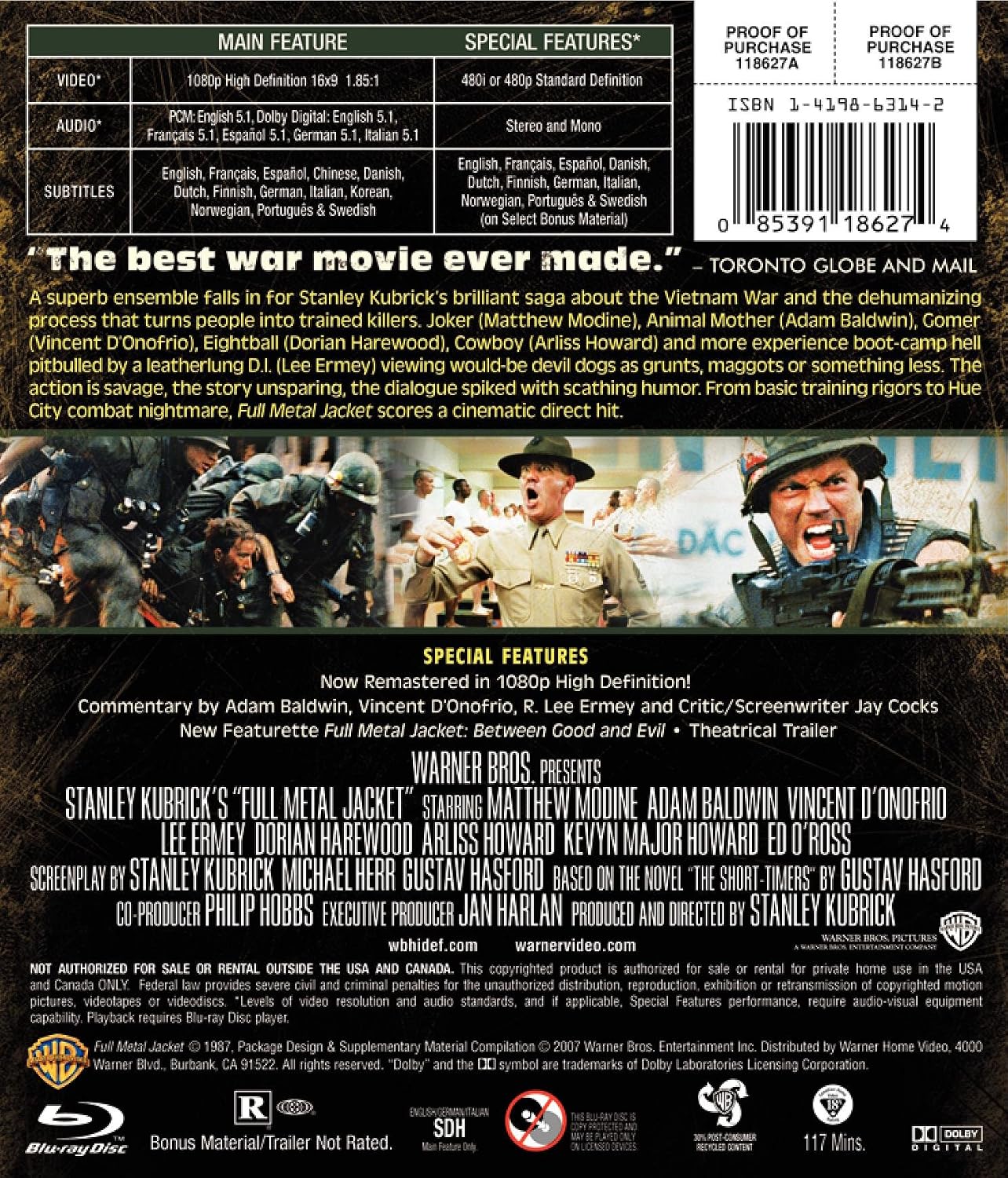
The Full Metal Jacket Blu-ray brings Stanley Kubrick's 1987 Vietnam War drama home in 1080p high definition, on Warner Bros.' original single-disc release from October 2007.
This listing is a pre-owned copy in Good condition. The disc is region free, so it plays in standard US Blu-ray players and game consoles.

Kubrick's film follows a group of young Marine recruits from the pressure of boot camp to combat in Vietnam. Kubrick wrote the screenplay with Michael Herr and Gustav Hasford, adapting Hasford's novel The Short-Timers.
Matthew Modine leads a cast that includes R. Lee Ermey, Vincent D'Onofrio, Adam Baldwin, Dorian Harewood and Arliss Howard. Ermey's performance as the drill instructor earned him a Golden Globe nomination, and the script was nominated for the Academy Award for Best Adapted Screenplay.
The film opened in the US on June 26, 1987, and earned about 120 million US dollars at the worldwide box office. The American Film Institute later placed it at number 95 on its 100 Years...100 Thrills list.
This is the first Warner Bros. Blu-ray of the film, not the later Deluxe Edition. It carries a lossless PCM 5.1 soundtrack and these extras:
Compared with the older DVD, the high-definition transfer on the Full Metal Jacket Blu-ray shows far more detail in the barracks scenes and in the smoke and rubble of the battle sequences. The lossless track also gives the gunfire, helicopters and music noticeably more weight and clarity. If you are weighing formats, our DVD vs Blu-ray guide explains the difference.
Pair this disc with another Kubrick title, A Clockwork Orange, or with Brian De Palma's Casualties of War. For a later take on Americans at war, try Three Kings on Blu-ray. You can read the film's full production history on Wikipedia.
Full Metal Jacket Blu-ray: Questions Buyers Ask
Is this the Deluxe Edition?
No. It is the original 2007 single-disc Warner Bros. Blu-ray with commentary, a featurette and the trailer.
Will it play in my US Blu-ray player?
Yes. The Full Metal Jacket Blu-ray is region free and plays in US Blu-ray players and consoles. It will not play in a DVD-only player.
Is the soundtrack lossless?
Yes. The English track is uncompressed LPCM 5.1, with Dolby Digital 5.1 options in five languages.
Is this copy new or used?
This Full Metal Jacket Blu-ray is a pre-owned copy in Good condition, and it is covered by our 30-day return policy.
If you have been searching for the Kubrick Full Metal Jacket disc in high definition, this copy is in stock and dispatched within 2 business days. Standard US shipping is $4.99, and orders over $50 ship free. See our return policy for details, then add it to your cart today.

Carluccio Viscera LeGrand –
Originally posted on Amazon.com · not a MarioShroomed purchase
Great Movie…True Account (rumored from vets) and Oh Yes of Course R. Lee. Ermey!!!
Even though Kubrick is (was) a serious anti-Vietnam proponent and critic of U.S. intervention, from what I’m told from Vietnam Vets (I have to rely on their testimonies because I wasn’t even born when Vietnam transpired—I just study the conflict), this movie is one of the most accurate depictions of the conscriptions of cadets to their actual deployment to Vietnam. R Lee Ermey, obviously gave such a truthful account of how drill instructors were during that time, that he is now a virtual immortal wet dream in the wannabes’ cult imagination…and a nostalgic throwback, for today’s top military brass, to the golden days when the Marines were “true killers” and the military didn’t have politeness procedures so, as not to offend, “hold overs” for prima donnas and was an institution that was deadly serious. I think that as an actual Gunnery Sgt., Sgt. R Lee was prophetic enough to fortell the comming total “screw job” of lax policy, anti-american politicians, general disdain and neglect for the US Armed Forces, corruption and horrible political correctness that has infiltrated the US Miltary in general since Vietnam.
I passed all of my military batteries with excellent scores but, I probably couldn’t have made it through BCT with a D.I. like Ermey (Sgt. Hartman) because, I would not have been able to keep a straight face or hold my breath long enough to avoid “crackin up” at some of his expositives;( I didn’t finalize my US ARMY enlistment or deploy either– I decided to finish graduate school and move to Germany instead). Nonetheless…R Lee is really the only reason that people continue to watch and love this film but, it became truly substantive with the company’s grueling and riveting entrance into the grim reality-scapes of Vietnam especially, when the sniper conflict became apparent. I still watch this movie pretty regularly for the aesthetics; even though the military is nothing like this account currently, (Sorry…but even the Marines have become P.C. and a little softer over the past decade), it is still definitely Class A work and worth the watch. If the U.S. Military and the U.S. Marines can get “born again hard” on the bottom line, they may return to a proxy like this account and any future prospective cadets should know and be prepared for the protocols and customs that they will be confronted with in B.C.T.
Oh Boy, the Po Boy –
Originally posted on Amazon.com · not a MarioShroomed purchase
Soft Core in a Hard Package
When I teach my film classes, I find that Kubrick (along with Hitchcock) is one of the most misunderstood filmmakers of the last century. Why is an essential component of this filmmaker (as well as others) lost in the translation? Part of it seems to be the separation between film history/criticism in the United States, where film enthusiasts seem content with the film alone, and forget that, prior to the internet, movies existed within a network of criticism that extended from the Westcoast Studios to the Eastcoast critics, and stretched overseas, where brilliant essayists like Truffaut were able to pick apart the latest offerings in the pages of the Cahiers du Cinema. These filmmakers used the theater as an extension of a critical dialogue that helped explain their core philosophies; the New york Critics and European Essayists were really cinematic linguists who helped to make sense of the “linguistic” complexity of a medium whose essential grammar seems to be more or less intuitive, both concrete and abstract.
The transition to more escapist fare (at least in the late 70s studio Hollywood system) has meant a transition in the critical world as well; with the popularity of the Cinematic Essayist waning in the last 20 years, being instead replaced by schtick and the “every man” approach to film reviews, and a cruel thumbs-up, thumbs-down approach — more or less a symptom of our collective attention deficit. While these approaches are necessary, the lack of educated “cinematic linguists” is resulting in the loss of understanding when it comes to our most important filmmakers, of which Kubrick is undoubtedly one.
For instance, it surprises most people to know that one of our most important stylists considered himself to be an “objective director.” Kubrick’s minimalist, nuanced, distanced style is really the product of his core philosophy which was to “observe” rather than to “impart.” Kubrick aligned himself with documentarians who used aesthetic restraint in crafting ethnographic narratives. In fact, if you really study the man — his writings, his interviews — you will find that his entire career was really a quest for cinematic truth. He constantly struggled against his own interpretation and impressions of events, to try to give a multi-faceted view of reality and drama, of which he believed that narrative itself was really an unnatural hallucination imposed on a series of random events by the mind’s need to rationalize and organize.
Kubrick struggled against not only studio narrative — the classic three-act structure — which he found predictable and as pedestrian as an overly familiar nursery rhyme; but he also resisted the narrative of the mind, its need to simplify, reduce, and impose. Even more than that, Kubrick struggled against the medium itself.
In an interview, Kubrick opined about the need to import rocks onto the set of Full Metal Jacket, to acquire the realism he knew would be beyond his reach with simulation. Sounding a lot like Jorge Luis Borges speaking about the problems of a truly realistic map, he explained the natural processes that would go into the formation of those rocks, with which Hollywood verisimilitude just could not compete. Importing those rocks is proof of Kubrick’s devotion to objectivity, which he felt was constantly compromised and corrupted by the cinematic medium itself (never mind that those rocks existed on a fabricated sound stage in London — but Kubrick’s philosophy on realism/formalism was always filled with contradictions).
It’s interesting to note that critical interpretation of Stanley Kubrick largely fails because it excludes the man’s own take on his own material. Never being one to shut down another’s opinion, Kubrick nevertheless had very strong and opinionated feelings about his own films, opinions that seem incredibly out-of-step with popular interpretation of his work.
I would like to remind the reader (whoever has been kind enough to stay with me thus far), an obvious fact, that will seem more obvious in retrospect — Kubrick had a lifelong fascination with the propagandistic nature of cinema as well as the theme of social brainwashing. A better word for brainwashing is “conditioning” as it’s broader and encompasses what Kubrick felt was the most consistent theme running throughout the entirety of his work. Kubrick was obsessed with how man’s psyche could be conditioned — through media, through government, through aristocracy, through peer pressure, etc. And in the end, he was fascinated by the struggle between an individual’s innate nature and the outside, coercive forces that threatened to eliminate his nature or suppress it once and for all.
“Full Metal Jacket” has the observationalist impulse of a documentary, the lyric quality of silent cinema, the rigorous technical prowess of Max Ophuls, and the elliptical, bifurcated narrative of an art house movie. In light of these influences, “Full Metal Jacket” is less an unconventional, frustrating war movie, than a logical realization of Kubrick’s core aesthetic principles as applied to the Viet Nam conflict. That being the case, what unites the two “halves” of Full Metal Jacket is the theme of “social conditioning.” A soldier is like a full metal jacket — his outer shell is formed by a rigid, brutalizing, indifferent, nearly industrial process, and yet, somewhere beneath is the soft material that can prove pliant and powerful in the wrong hands. Viewed from this perspective, the second half of “Full Metal Jacket” is not as off-putting as some have unfairly suggested. For those who are intimately familiar with the man’s philosophies, the “second half” is a natural consequence of the first half, and succeeds brilliantly in emphasizing Kubrick’s fascination with man’s duality — a duality that becomes more apparent in a sustained and prolonged conflict between two national dualities.
(If you really want insight into the work of Kubrick or other filmmakers, do not divorce them from their influences, or their own philosophies which exist in interviews, private notes, and other secondary and third sources).
Fea –
Originally posted on Amazon.com · not a MarioShroomed purchase
Classic
Classic