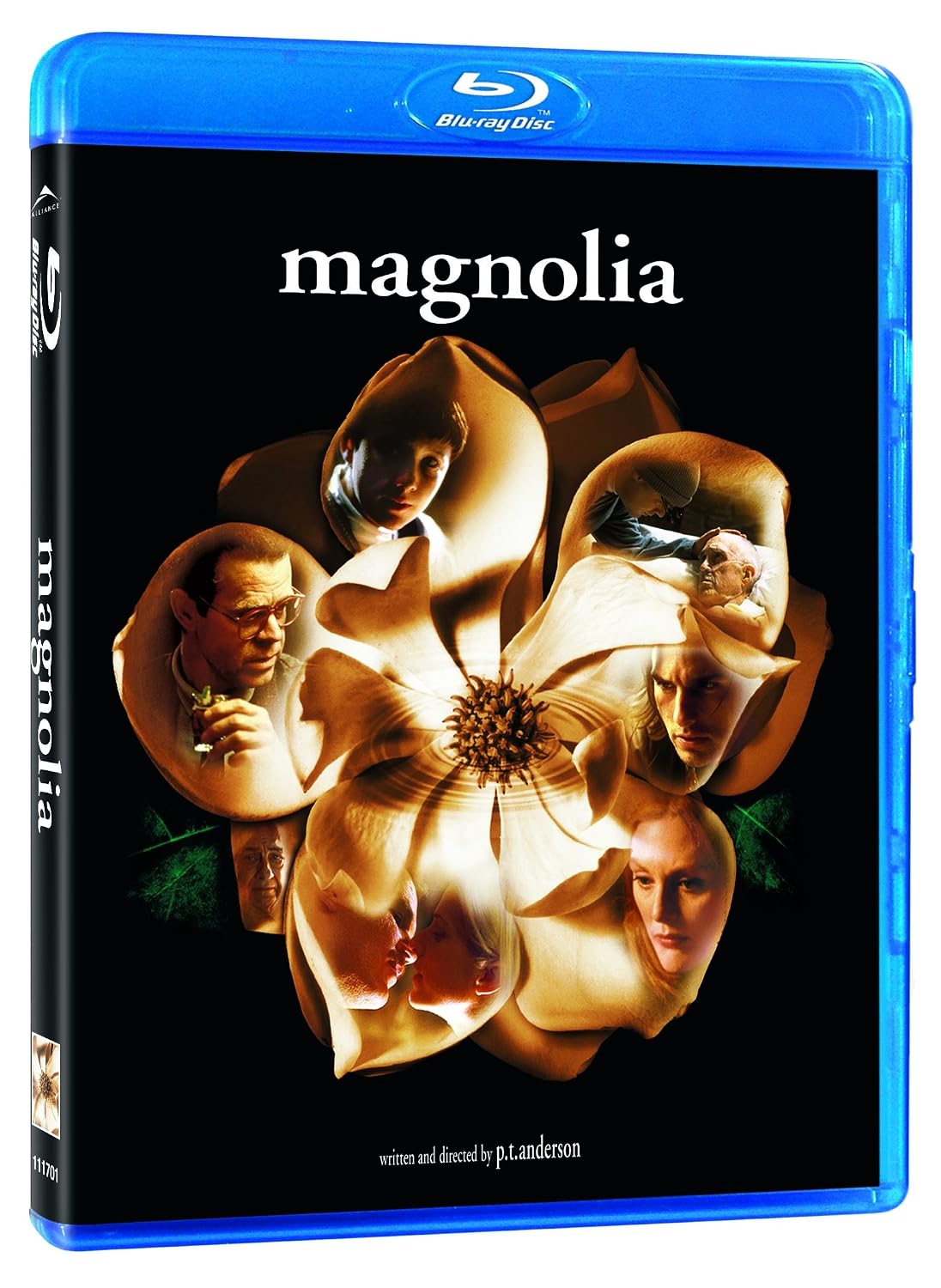
The Magnolia Blu-ray brings home Paul Thomas Anderson's 1999 ensemble drama, a three-hour mosaic of lives that cross over one long day in California's San Fernando Valley. Tom Cruise, Julianne Moore, Philip Seymour Hoffman, Jason Robards, John C. Reilly and William H. Macy lead the ensemble cast.
This is a Blu-ray disc, so you will need a Blu-ray player or a game console that plays Blu-ray discs. It will not play in a standard DVD-only player.
What's in the Magnolia Blu-ray
- Film: Magnolia (1999)
- Writer and director: Paul Thomas Anderson
- Starring: Tom Cruise, Julianne Moore, Philip Seymour Hoffman, Jason Robards, John C. Reilly, William H. Macy, Philip Baker Hall and Melora Walters
- Studio: New Line Cinema
- Runtime: about 188 minutes
- Music: songs by Aimee Mann, score by Jon Brion
- Format: Blu-ray
The Story of Magnolia
Magnolia follows a group of strangers whose lives are quietly linked. Earl Partridge asks his nurse to find his estranged son, while Jimmy Gator, host of the quiz show What Do Kids Know?, is dying of cancer. Around them are a Los Angeles police officer, a former quiz-show champion and the show's newest child prodigy, each with a story of their own.
Tom Cruise plays Frank T.J. Mackey, a coarse but charismatic motivational speaker who turns out to be Earl's estranged son. Jason Robards, in his final film role, plays Earl, with Philip Seymour Hoffman as his caring nurse, Phil Parma. The intercut stories even include a rain of frogs.
Awards, Music and Why It Lasts
Magnolia opened in limited release on December 17, 1999 and went wide on January 7, 2000. It won the Golden Bear at the Berlin International Film Festival, and Tom Cruise won the Golden Globe for Best Supporting Actor.
The film earned three Academy Award nominations: Best Supporting Actor for Cruise, Best Original Screenplay for Anderson, and Best Original Song for Aimee Mann's "Save Me". The script itself was inspired by Mann's music, and her songs run through the whole film.
At just over three hours, Magnolia rewards a big screen and a quiet evening. Owning the 1999 movie on Blu-ray means you can watch it in high definition whenever you like, with no streaming rotation to worry about.
More Movies on DVD/Blu-ray
Browse our full range of Blu-ray movies and TV or explore more movies on disc. Wondering what the upgrade gets you? Read our guide to DVD vs Blu-ray. For the full cast and production history, see the Wikipedia article on Magnolia.
Magnolia Blu-ray: Questions Buyers Ask
How long is Magnolia?
The film runs about 188 minutes, just over three hours.
Will the Magnolia Blu-ray play in my DVD player?
No. It needs a Blu-ray player or a console that plays Blu-ray discs.
Who directed Magnolia?
Paul Thomas Anderson wrote and directed it as the follow-up to his 1997 film Boogie Nights.
Did Magnolia win any awards?
Yes. It won the Golden Bear in Berlin, and Tom Cruise won a Golden Globe. It also earned three Oscar nominations.
Order the Magnolia Blu-ray
The Magnolia Blu-ray is in stock and dispatched within 2 business days. Standard US shipping is $4.99, and orders over $50 ship free. See our 30-day return policy, then add the Magnolia Blu-ray to your cart for a memorable movie night.

Mathias Kruss –
Originally posted on Amazon.com · not a MarioShroomed purchase
Andrew Ellington –
Originally posted on Amazon.com · not a MarioShroomed purchase
And frogs fell from the heavens…
Paul Thomas Anderson is a remarkable creative mind. That being said, `Magnolia’ isn’t as strong as it could have been. That isn’t to say that the film doesn’t have merit, because it is authentic and truly earnest; perhaps too much so. The one thing that kept springing to mind while watching this film was that it lacked balance. This is the last of Anderson’s films for me to see, and so it’s odd for me that this is one of his most raved (possibly his most raved) film to date. While the Academy embraced his latest (and greatest) masterpiece, `There Will Be Blood’, there are many vocal detractors to that film, while little is said to degrade `Magnolia’; a film that is considered by many to be an intellectual masterpiece of modern cinema.
The film is good, but it is missing something.
Like I said, `Magnolia’ lacks balance. It surprises me, because that is one thing I find so fascinating about Anderson’s other work; they are so balanced. Even something as dark as `There Will Be Blood’ is emotionally landscaped in way so that you can feel the ups and downs, the highs and lows with precise effect. Anderson maps out his scenes in such a way that you `get’ them. `Boogie Nights’ balanced tones so effortlessly; creating such robust feelings that ran the gamut of witty and charming to eerily aggressive; and it all flowed. Even a film as `uneven’ as `Punch Drunk Love’ felt remarkably well thought out (despite my lack of true passion for the film, I easily consider Anderson’s direction exceptional). Going all the way back to his debut, `Hard Eight’, it is notable the way that Anderson plays with darkness in a way that feels eerily accessible.
There are no swells in `Magnolia’. It is somewhat one-note. There is one emotion that permeates the entire film. It is depressing. One depressing scene after another depressing scene. I mean, the middle of the film felt like the end of the film because even the music was making me feel like the whole world was going to end and everyone was going to die that very moment and yet it still had over an hour and a half to go before the film ending. I have never felt so depressed watching a film in all my life; to the point where the conclusion truly brings no resolve or lifted spirits because it is too little too late.
The damage had already been done.
But, there is something about this film that speaks to me. As with all of Anderson’s films, I feel that this is one to be seen again and again before it can be appreciated. I mentioned, in my review title, a sliver of the film’s conclusion, and it is a moment that took me by complete surprise and helped me to appreciate it all the more. It felt right, despite being so off. It added a layer to this film that I wholly need to explore.
I just wish that the film had more shades to it.
That being said; the film is an acting goldmine. Philip Baker Hall and Jason Robards are phenomenal as the film’s dying patriarchs, both of whom have debts to pay to their children. Julianne Moore is heartbreaking and completely sincere as the trophy wife with a plateful of regret. William H. Macy and Jeremy Blackman complement one another beautifully, playing the same role just decades apart. John C. Reilly is so tender and relatable as the insecure cop who catches a break with the wrong woman. But it is Philip Seymour Hoffman and Tom Cruise who really steal every scene. Their characters could be more different and yet they emote so deeply. Cruise is a firecracker, throwing charisma at everyone in his path and yet it is his emotional breakdown that feels the most real; considering that his entire persona is built upon a façade. It is Hoffman who grabbed me the most though. The way he uncovers us layers of true caring while watching over Cruise’s dying father; its remarkable how much his eyes convey.
The film; an interwoven collage related stories, has its moments, and the actually concept is one that I find inspired. In fact, I kind of find this film utterly fascinating. Like many have said about most all Anderson’s work; it is flawed and yet it is unforgettable.
Anderson has undeniably honed his skill as a director. His work on `There Will Be Blood’ is almost untouchable (a directorial achievement that grows in my estimation every time I merely `think’ of the film), and his promise is seen all over this film that is slightly `over-achieved’.
This is not his worst film (but `worst’ is not really a word to be used with his films), but that isn’t a consolation when, with a little more focus given to layering the emotions, this could have been a clear masterpiece.
And yet, maybe it is a masterpiece.
Scrimshaw –
Originally posted on Amazon.com · not a MarioShroomed purchase
The Real Misery Movie
Magnolia, a 1999 drama film written and directed by P.T. Anderson, is in Anderson’s own words, “probably the best film I’ll ever make”, which is wrong, as that honor goes to There Will Be Blood, at least in my eyes. The film itself is similar to, and slightly better, than another film released just a year earlier called Happiness. It’s also very similar, apparently, to a 1993 Robert Altman film called Short Cuts. It features an ensemble cast of well-known big name stars such as Tom Cruise, Julianne Moore, Philip Seymour Hoffman, John C. Reilly, William H. Macy, and Alfred Molina, in a small supporting role. There are also relative unknowns such as Melora Walters, Phillip Baker Hall, and Jeremy Blackmon, in no less important roles. The vast majority of characters in this film are relatively unlikable, annoying, vulgar, and miserable people, many of whom have or are themselves bad fathers, cheating spouses, and incompetent workers. The film is three hours long and takes place in the San Fernando Valley of California, like all of P.T. Anderson’s films. It follows all of the previously mentioned characters in search of love, happiness, forgiveness, and redemption. In addition to that all of the characters are connected, sometimes loosely, sometimes strongly, to eachother. William H. Macy plays former whiz kid Donnie Smith who was apparently struck by lightning and lost all of his “smarts”, he was a contestant on a game show called “What Do Kids Know” and is now a miserable lonely man who seems lost and abandoned, in the beginning he gets fired from his job and it all goes downhill for him from there. Jeremy Blackmon plays Stanley Spector, a new “whiz-kid” on What Do Kids Know who has a sorry excuse for a father and seems to be heading down the same path as William H. Macy’s character, he’s also one of the most likable and sympathetic characters in the film along side John C. Reilly’s character Officer Jim Kurring, who, believe it or not, is an LA Cop. His character felt far too naive and optimistic for a officer working in LA. Vermont or Alaska maybe, but definitely not in a place like Los Angeles could a cop be that innocent. However, for better or worse it’s his character, and Jeremy’s, that saves this film from a two star rating, so I guess he’s not that bad. He has an odd romantic relationship with Claudia Gator, the daughter of What Do Kids Know host Jimmy Gator, who are played by Melora Walters and Phillip Baker Hall respectively. Claudia is a drug addict who hates her father and this is made clear in an intense early scene when he tells her he’s dying from cancer. Tom Cruise plays Frank T.J. Mackey, a self help specialist who runs a seminar aimed at men that teaches them how to charm and seduce women into bed with them. In a different role from what he usually plays, Cruise as Frank is a vulgar, sleazy, and bitter man who seems to be running or hiding from something in his past, and Seduce and Destroy appears to a consequence of it. This is made clear in an interview with a woman that he agrees to during one of his seminars. Jason Robards plays his terminally ill father who spends the entire film in bed attended to by his kind male nurse played by Philip Seymour Hoffman. Franks hates his father for cheating on, and later abandoning, his cancer-stricken wife who later died, and him, who was forced to take look after her by himself. Julianne Moore plays Jason Robard’s character’s second wife who only married him for his money and wants to change his will to leave all of his valuables to her after he dies, and she also cheats on him. She is probably the weakest character in the film, as her performance is marred by over-acting and clumsy dialogue. She also has a vendetta against Frank, claiming he’s not part of their family. In addition to these loosely connected plot threads, there is the common theme of chance and coincidence, best illustrated at the beginning of the film in a darkly humorous monologue focusing on three incredible coincidences that supposedly really happened and in a scene towards the very end which I won’t spoil for you. Many people claim that Magnolia is a pretentious film and that Anderson was deliberately trying to be as obscure or confusing as possible to make it seem like a deeper or more profound film than it actually was. I believe there’s a bit of truth to that, but not to the extent that some people here think. It wasn’t all that confusing to me, the thing that bothered me the most was the overuse of melodrama and miserable, pathetic characters interacting with other miserable, pathetic characters. It felt almost like a soap opera, and the vulgar language was also overdone, to the point of actually taking away from the effectiveness of several scenes, especially one towards the end involving Frank. Overall it was easy to sympathize with many of the characters but hard to like them, which was a big negative for me concerning the quality and effectiveness of the film. It has a huge cast and a long running time, but it still felt oddly incomplete when the credits started to roll. Overall it was an okay film, but not great or a masterpiece, and definitely not Paul Thomas Anderson’s best film.